Every enterprise AI security program now faces the same paradox: the technology that helps defenders catch threats faster is the same technology attackers are using to launch them. Security leaders can no longer treat AI as a future consideration — it is already reshaping how threats are researched, how networks are monitored, how incidents are resolved, and how vulnerabilities are patched. This guide walks through exactly what an AI-driven security program looks like in practice, backed by current industry data, and gives security and IT leaders a practical, step-by-step framework for building one.
Why AI Security Programs Matter Right Now
The numbers make the case better than any sales pitch. According to IBM's 2025 Cost of a Data Breach Report, the global average cost of a breach fell to $4.44 million — a 9% year-over-year drop driven largely by faster detection and containment powered by AI-enabled security tools. Organizations that used AI extensively across their security operations cut breach lifecycles significantly and saved close to $1.9 million per breach compared to those that didn't.
At the same time, the report found that mean time to identify and contain a breach dropped to 241 days — the lowest figure in nine years. That improvement is not incidental. It reflects a broader shift: AI is no longer a "nice to have" bolted onto legacy security stacks — it's becoming the backbone of how modern security programs operate.
Gartner reinforces this trajectory from a spending perspective. Its 4Q25 forecast projects global information security spending will reach $244.2 billion in 2026, up more than 13% year-over-year, with a newly created AI-cybersecurity market segment nearly doubling in size within the year. Gartner also projects that more than 75% of enterprises will use AI-amplified cybersecurity products by 2028, up from less than a quarter in 2025.
The implication is simple: an AI security program isn't an emerging trend to monitor from the sidelines. It's fast becoming table stakes for enterprise risk management — and the organizations that delay are, according to the data, ending up on the more expensive, more exposed side of the ledger.
The 2026 AI Security Landscape
Three forces are converging to make 2026 an inflection point for AI in cybersecurity. First, attacker tooling has matured — IBM found that roughly 1 in 6 breaches now involve attackers using AI themselves, most commonly for phishing and deepfake impersonation. Second, defensive AI has matured alongside it, moving from experimental pilots to production-grade platforms embedded in SIEM, SOC, and endpoint tooling. Third, and most consequential, agentic AI — systems that can act autonomously rather than just analyze and recommend — has entered mainstream enterprise deployment. Gartner named agentic AI oversight the number-one cybersecurity trend for 2026, noting that autonomous cybersecurity response agents are projected to appear in roughly 40% of enterprise applications by the end of the year, up from under 5% at the start of it.
This creates a genuinely new kind of risk surface. It's no longer just about whether an organization's data and endpoints are secure — it's about whether the AI systems making decisions inside the security stack are themselves governed, auditable, and bounded in what they're allowed to do autonomously. That distinction runs through every section below.
1. Faster Threat Research at Scale
Security teams have always been outnumbered — a handful of analysts against an internet's worth of adversaries. AI changes that math. Instead of manually triaging threat feeds, research papers, and vulnerability disclosures, AI models can ingest and correlate millions of data points in the time it takes a human analyst to read a single report.
This isn't just about speed — it's about surfacing patterns a human would never catch manually: subtle correlations between disparate indicators of compromise, emerging attacker tooling discussed across forums, or early signals of a novel exploit technique. For enterprises building custom threat intelligence pipelines, this typically involves large language models fine-tuned or prompted specifically for security research, integrated directly into SIEM and threat intelligence platforms rather than used as a generic chatbot bolted on the side.
What this looks like in practice
- Automated summarization of newly disclosed CVEs, mapped against the organization's actual asset inventory
- Continuous monitoring of dark web and forum chatter for mentions of the company's domains, credentials, or brand
- Natural-language querying of historical incident data, so analysts can ask "have we seen this attack pattern before?" instead of grepping through logs
Companies exploring this capability often start with a generative AI solution built around their existing security data lake, rather than a generic off-the-shelf tool — because threat research at enterprise scale requires models trained to understand the organization's own attack surface, not just public threat feeds.
2. Real-Time Network Anomaly Detection
Traditional network monitoring relies on static rules and known signatures — effective against yesterday's attacks, blind to tomorrow's. AI-driven anomaly detection instead builds a behavioral baseline for every user, device, and service on the network, then flags deviations in real time.
A single compromised credential logging in from an unusual location, a device suddenly transferring abnormal volumes of data, or a service account behaving outside its normal pattern — these are exactly the kinds of subtle signals that rules-based systems miss and machine learning models are built to catch. This matters because attackers increasingly rely on "living off the land" techniques — using legitimate admin tools and credentials rather than obvious malware — specifically to avoid tripping traditional alarms.
Gartner's 2026 cybersecurity trends report specifically calls out AI-driven security operations centers (SOCs) as a top trend reshaping how alert triage and investigation happen at enterprise scale. The tradeoff worth planning for: AI-driven SOCs increase productivity but also introduce new operational complexity, and Gartner cautions that teams need continued human oversight and upskilling to interpret what these systems are flagging, rather than trusting the output blindly.
3. Smarter Web and Endpoint Protection
Phishing has overtaken stolen credentials as the most common initial attack vector, responsible for roughly 16% of breaches at an average cost of $4.8 million. Generative AI has made this worse on the attacker side too — as noted above, AI-assisted phishing and deepfake impersonation are now common initial access techniques.
On the defensive side, AI-powered endpoint protection platforms analyze behavior rather than just matching known malware signatures. This means they can catch a phishing site that was registered an hour ago, or a malware variant that has never been seen before, based on how it behaves rather than what it looks like on disk.
Why signature-based tools fall short
A traditional antivirus engine needs a known signature to recognize a threat — which means it's structurally incapable of catching anything genuinely new on day one. Behavioral AI models instead ask: is this process trying to encrypt files rapidly? Is this script attempting to disable security tooling? Is this connection reaching out to infrastructure with no prior reputation? Those questions catch novel threats that signature databases simply can't.
For enterprises with distributed workforces and BYOD policies, this kind of real-time, behavior-based protection has become a baseline requirement rather than a differentiator — which is why it typically sits inside a broader cybersecurity services engagement covering vulnerability scanning, zero-trust access, and encryption alongside endpoint defense.
4. Securing Cloud Data and Encrypted Traffic
Most enterprise data today lives across a mix of public cloud, private cloud, and on-premises systems — and that hybrid sprawl carries a real cost. IBM found that breaches involving data spread across multiple environments cost an average of $5.05 million, compared to $4.01 million for breaches confined to on-premises systems.
One of AI's more underappreciated capabilities here is analyzing encrypted traffic without decrypting it. By examining traffic patterns, packet timing, and metadata rather than payload content, machine learning models can flag malware communicating over HTTPS or detect data exfiltration attempts — all without breaking encryption or compromising user privacy. This is particularly relevant for organizations subject to GDPR, HIPAA, or similar data protection regulations, where decrypting traffic for inspection isn't always a viable — or legal — option.
Building this kind of AI-aware, privacy-preserving monitoring into cloud environments generally requires close collaboration between security and infrastructure teams — which is where cloud infrastructure and DevOps expertise becomes essential, since detection logic needs to be embedded directly into the network topology at design time, not bolted on afterward.
5. Incident Response Co-Pilots: Human + AI Collaboration
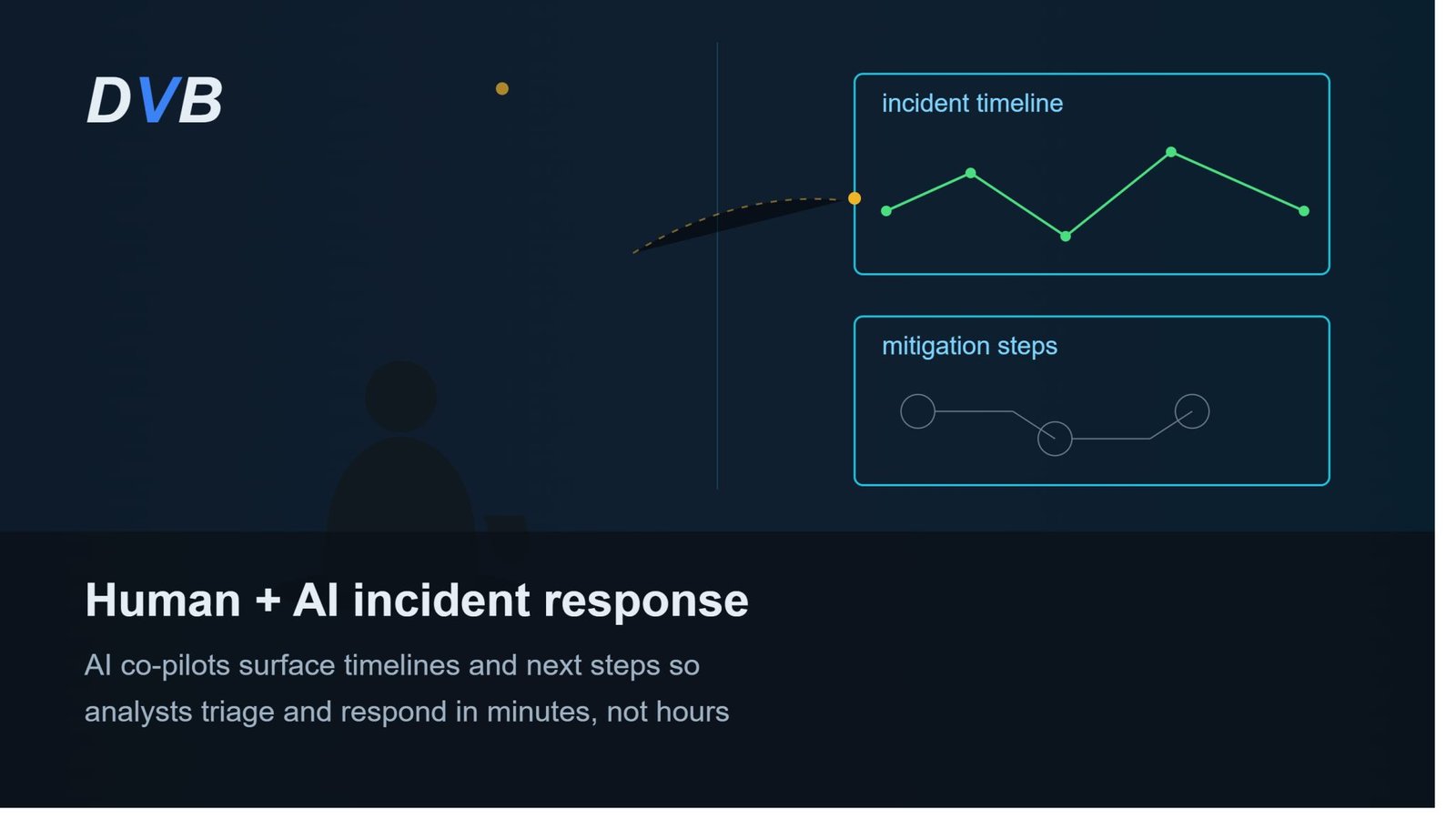
Perhaps the most immediately practical application of AI in security programs is the incident response co-pilot — an AI system that sits alongside human analysts during an active incident, surfacing relevant context, suggesting mitigation steps, and automating routine containment actions while a human retains decision authority over anything consequential.
This matters because response speed directly correlates with cost. IBM's data shows breaches identified and contained by internal teams cost an average of $4.18 million, versus $5.08 million when discovered by an attacker or third party. An AI co-pilot that shortens the gap between detection and informed action has a direct, measurable impact on breach cost.
Gartner takes this further, predicting that autonomous cybersecurity response agents — systems that scan network traffic, analyze logs, and initiate responses with minimal human intervention — will be present in roughly 40% of enterprise applications by the end of 2026, up from under 5% at the start of the year. That's a rapid shift, and one that requires careful governance: Gartner names agentic AI oversight the top cybersecurity trend for 2026, warning that ungoverned autonomous agents create new, hard-to-see attack surfaces. Forrester's 2026 predictions go further still, forecasting that a publicly disclosed breach caused by an agentic AI deployment is likely within the year.
Enterprises building agent-based response systems need this governance layer designed in from day one — which is a core part of how agentic AI solutions should be architected for regulated industries: with clear boundaries on what an agent can act on autonomously versus what always requires human sign-off.
6. Continuous Vulnerability Management
Vulnerability management used to be a periodic exercise — quarterly scans, prioritized patch cycles, and a lot of manual triage. AI is turning it into a continuous process. Machine learning models can now prioritize vulnerabilities not just by CVSS severity score, but by actual exploitability in the wild, exposure within the specific environment, and the likely business impact if compromised — dramatically cutting down the noise security teams have to wade through.
This shift matters because the alternative — manual, periodic reviews — simply can't keep pace with how quickly new AI-related risks are emerging. Gartner projects that through 2030, roughly a third of all IT work will be spent remediating "AI data debt" just to make organizational data secure enough for safe AI use. Continuous, AI-assisted vulnerability management isn't a luxury in that environment — it's a necessity for keeping pace.
Traditional vs. AI-Driven Security Operations
| Function | Traditional approach | AI-driven approach |
|---|---|---|
| Threat research | Manual review of feeds and reports | Automated correlation across millions of signals in near real time |
| Network monitoring | Static rules and known signatures | Behavioral baselining with real-time anomaly detection |
| Endpoint protection | Signature-based malware matching | Behavior analysis that catches novel, zero-day threats |
| Vulnerability management | Periodic scans, severity-only prioritization | Continuous scanning, prioritized by real-world exploitability |
| Incident response | Manual triage, runbook-driven | AI co-pilot surfaces context and next steps in real time |
Building an AI-Ready Security Program: A Practical Roadmap
Adopting AI across a security program isn't a single project — it's a layered rollout. Based on how the most mature programs are approaching it, four phases stand out.
1Start with data readiness
AI models are only as good as the data they're trained and run on. Fragmented logs, inconsistent labeling, and siloed telemetry will undermine even the best AI tooling. Before evaluating any AI security platform, audit where your logs, alerts, and asset inventories actually live — and whether they're structured consistently enough for a model to reason over. This is frequently where data engineering work needs to happen first, well before any AI model gets deployed.
2Govern before you scale
IBM found that 63% of breached organizations lacked any AI governance policy, and of the organizations that did suffer an AI-related incident, 97% lacked proper AI access controls. Governance has to be in place before AI tools go into production, not retrofitted after an incident. At minimum, this means defined approval processes for new AI tools, access controls scoped to least privilege, and regular audits of what AI systems can see and do.
3Pilot with human-in-the-loop, then earn autonomy
AI co-pilots should accelerate human judgment before they're ever allowed to replace it — particularly for actions with legal, financial, or customer-facing consequences. Start with advisory-only deployments: the AI recommends, a human approves. Expand autonomy only for narrowly scoped, low-risk actions (e.g., isolating a single endpoint) once the system has demonstrated reliability over time.
4Treat AI systems as high-value assets in their own right
AI models and the data pipelines feeding them are now attack targets, not just tools. IBM reports that 13% of surveyed organizations have already experienced an attack that directly impacted their AI models or applications. That means AI infrastructure needs the same rigor as any other production system: access logging, change management, and inclusion in the incident response plan.
Industry-Specific Considerations
AI security programs don't look identical across industries — regulatory context shapes what's possible and what's required.
- Financial services: Encrypted traffic analysis and fraud-pattern detection carry particular weight, alongside strict audit trail requirements for any autonomous action an AI agent takes.
- Healthcare: HIPAA constraints mean AI models handling PHI need explicit data segregation, and any AI vendor or model needs to fit inside a signed BAA framework.
- Government and public sector: Data sovereignty and explainability requirements often rule out black-box models entirely in favor of auditable, interpretable AI systems.
- Retail and e-commerce: High transaction volume makes real-time anomaly detection for payment fraud one of the highest-ROI AI security investments.
Working with a partner that already operates under SOC 2 Type II, ISO/IEC 27001, GDPR, and HIPAA-aligned frameworks matters here — it shortens the governance conversation considerably compared to starting from scratch with a vendor unfamiliar with regulated environments.
Common Challenges When Adopting AI in Security Programs
Shadow AI. Employees adopting unsanctioned AI tools without security oversight is now a measurable cost driver — IBM found shadow AI added an average of $670,000 to breach costs where it was a factor, largely due to broader data exposure and longer detection times.
Alert fatigue shifting, not disappearing. AI reduces noise from known threat patterns but can introduce new categories of false positives as models are tuned. Teams need realistic expectations and a feedback loop to continuously retrain detection models based on analyst corrections.
Skills gaps. Gartner warns that security teams who don't invest in upskilling risk losing the ability to critically evaluate what their own AI tools are telling them — a dangerous position when AI-driven SOCs are handling first-pass triage.
Budget mismatch. Enterprises are currently investing far more in AI-powered security tools than in securing the AI systems themselves, according to Gartner's spending analysis — a gap that needs deliberate correction as agentic AI adoption accelerates.
Measuring ROI: KPIs That Actually Matter
Vanity metrics like "alerts processed per day" don't tell you whether an AI security program is working. Track these instead:
- Mean time to detect (MTTD) and mean time to contain (MTTC) — the two metrics IBM's research ties most directly to breach cost
- False positive rate trend over time, to confirm models are actually improving rather than just shifting noise around
- Percentage of incidents resolved without escalation, as a proxy for co-pilot effectiveness
- AI governance coverage — what percentage of deployed AI tools have documented access controls and audit trails
- Shadow AI incidents detected, ideally trending toward zero as governance matures
Glossary of Key Terms
| Term | Definition |
|---|---|
| Agentic AI | AI systems capable of taking autonomous action — not just analyzing and recommending — within defined boundaries. |
| Shadow AI | AI tools or platforms used by employees without security or IT approval and oversight. |
| SOC (Security Operations Center) | The team and systems responsible for continuous monitoring and response to security threats. |
| IAM (Identity and Access Management) | Systems and policies governing who — human or machine — can access what, and under what conditions. |
| AI TRiSM | Trust, Risk, and Security Management for AI systems — a Gartner-coined framework for governing AI deployments. |
The Future of AI-Driven Security Programs
The direction of travel is clear: AI is moving from an assistive layer bolted onto existing security tools to the operational core of how enterprise security programs function — research, detection, response, and remediation, all running on AI-augmented workflows with human oversight at the decision points that matter most.
Organizations that treat this as a strategic, governed transformation — rather than a scramble to deploy point tools — are the ones seeing measurable cost and speed benefits today. Aligning AI adoption with an established framework like NIST's Cybersecurity Framework 2.0 can help structure that transformation rather than treating AI as a bolt-on initiative disconnected from core security governance.
Ready to Build an AI-Driven Security Program?
Whether you're starting with AI-assisted threat research or architecting a fully governed agentic response system, the right implementation depends on your existing infrastructure, compliance requirements, and risk tolerance.
Book a Free ConsultationFrequently Asked Questions
What is an AI security program?
An AI security program is a cybersecurity strategy that embeds AI and machine learning across core security functions — threat research, network monitoring, endpoint protection, cloud security, incident response, and vulnerability management — rather than treating AI as a single isolated tool.
Does AI reduce the cost of a data breach?
Data suggests it can. Organizations using AI extensively across security operations have reported significantly shorter breach lifecycles and meaningfully lower breach costs compared to organizations with little to no AI-driven security tooling.
What is the biggest risk of adopting AI in a security program?
Ungoverned adoption. Deploying AI tools without access controls, audit processes, or clear governance policies is consistently associated with higher breach costs and greater exposure in industry research.
Do I need autonomous AI agents for incident response?
Not necessarily as a first step. Most organizations start with AI-assisted triage and analyst co-pilots before moving toward more autonomous response agents, given the governance and oversight requirements involved.
How long does it take to build an AI-driven security program?
Most mature programs take 6 to 18 months to move from data readiness through pilot deployment to broad rollout, depending on the size of the environment, regulatory requirements, and existing data infrastructure maturity.
What is shadow AI and why does it matter for security programs?
Shadow AI refers to AI tools employees adopt without security or IT approval. It matters because breaches involving shadow AI cost organizations hundreds of thousands of dollars more on average than standard incidents, largely due to reduced visibility and control.
Related Reading
Sources: IBM Cost of a Data Breach Report 2025 · Gartner: Top Cybersecurity Trends for 2026 · Gartner: AI Applications Will Drive 50% of Incident Response Efforts by 2028 · NIST Cybersecurity Framework 2.0